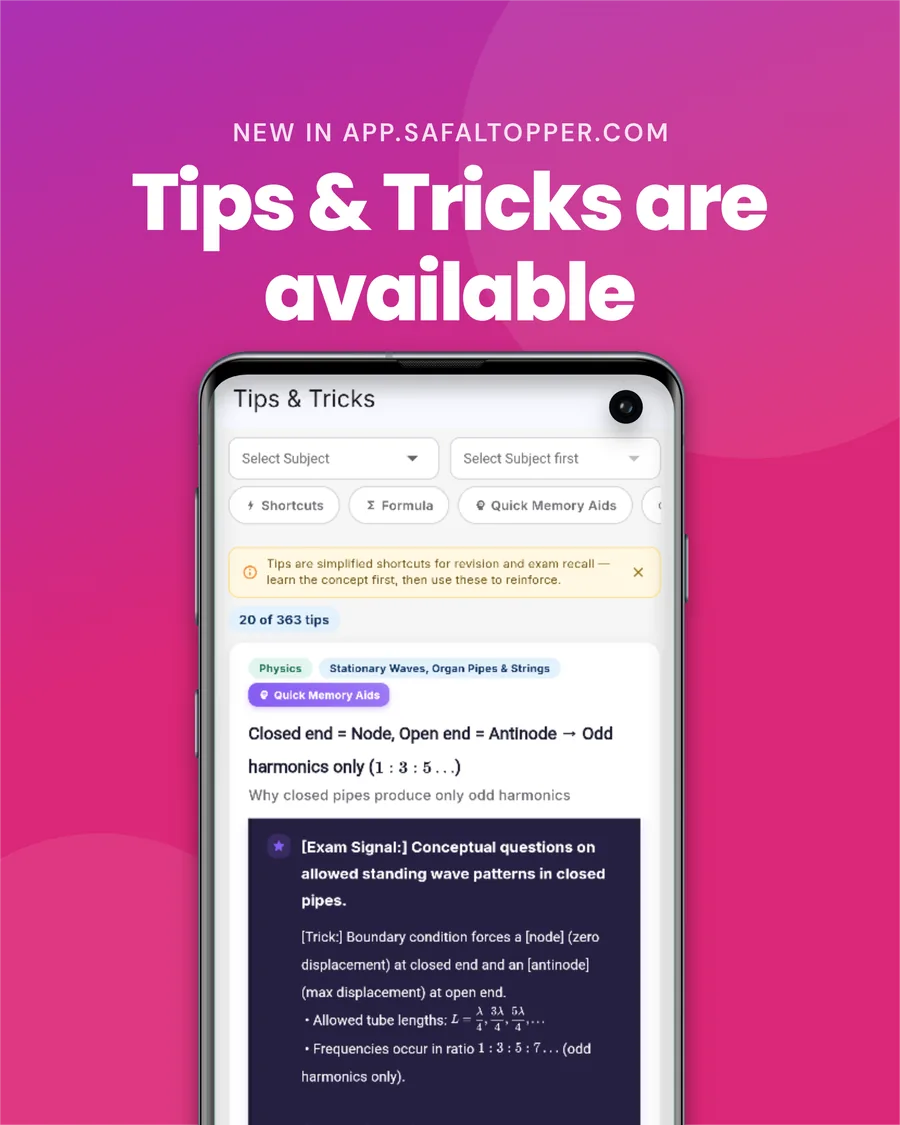
General rule for open vs closed circulatory system — where does blood actually go?
Memory hook: Open = blood spills into body spaces. Closed = blood stays in pipes.
Rule: In open circulatory system, heart pumps blood (haemolymph) into open spaces (haemocoel) that bathe organs directly. In closed system, blood stays within vessels (arteries → capillaries → veins) and never directly contacts tissues.
Example: Cockroach = open; Earthworm = closed. If the question asks "In which does blood reach cells via capillaries?" → closed only.
ABO blood group quick revision — who donates to whom, and why?
Memory hook: Group O = universal donor (no antigens to reject). Group AB = universal recipient (no antibodies to attack).
Rule: Blood group = which antigens are on RBC surface. Antibodies are in plasma against the antigens you LACK. O has no A/B antigens → safe to give to anyone. AB has both antigens → can receive from anyone. Rh+ has Rh antigen; Rh- lacks it.
Example: Group A person has A-antigen + anti-B antibody. If you give them B blood → agglutination. Exam trick: "Can AB+ receive from O-?" → Yes (universal recipient), but O- can only receive from O-.
Excretory product by habitat — which animals excrete which nitrogenous waste?
Memory hook: A-U-U order: Ammonia → Urea → Uric acid. More water you have, more toxic waste you can afford.
Rule: Ammonia (most toxic, needs lots of water) → aquatic animals. Urea (moderate toxicity) → mammals, adult amphibians. Uric acid (least toxic, paste-like) → birds, reptiles, insects — conserves water. The less water available in habitat, the less toxic the waste product must be.
Example: Fish excrete ammonia; humans excrete urea; birds excrete uric acid (white paste). Exam trap: "Adult frog excretes urea, tadpole excretes ammonia" — because tadpole is aquatic!
Mendel's three laws — which order, and what does each actually say?
Memory hook: D-S-I: Dominance → Segregation → Independent Assortment. One gene at a time, then two genes.
Rule: Law of Dominance = in a heterozygote, one allele masks the other (Tt shows tall). Law of Segregation = two alleles for a gene separate during gamete formation (each gamete gets one). Law of Independent Assortment = genes on different chromosomes assort independently (gives 9:3:3:1 dihybrid ratio).
Example: If exam says "9:3:3:1 ratio demonstrates which law?" → Independent Assortment. If it says "Tt shows tall, not intermediate" → Dominance. If "Tt × Tt gives 3:1" → Segregation (alleles split).
Reflex arc neuron sequence — which neuron fires first, second, third?
Memory hook: R-S-I-M-E: Receptor → Sensory (afferent) → Interneuron (CNS) → Motor (efferent) → Effector (muscle/gland).
Rule: Reflex arc bypasses the brain for speed. Pathway: Stimulus → Receptor → Sensory neuron (afferent, cell body in dorsal root ganglion) → Interneuron (in spinal cord grey matter) → Motor neuron (efferent, cell body in ventral horn) → Effector (muscle contracts or gland secrets). Synapse direction is always sensory → motor (chemical, one-way).
Example: Touching a hot pan — you pull your hand before feeling pain. The sensory neuron carries signal to spinal cord; interneuron relays to motor neuron; muscle contracts. Pain signal goes to brain separately (slower). Exam trap: "Sensory neuron cell body location?" → Dorsal root ganglion (NOT ventral).
Body organisation levels — which organism has which level?
Memory hook: Cellular → Tissue → Organ → Organ-system. Each phylum gains one level. Hydras have tissue level; flatworms have organ level; earthworms have organ-system.
Rule: Sponges = cellular level (no true tissues). Cnidarians (Hydra, jellyfish) = tissue level. Flatworms = organ level (no organ-system). Annelids onward = organ-system level. The more complex the organism, the higher the organisation level.
Example: "Hydra shows tissue level of organisation" — TRUE. "Earthworm has organ-level only" — FALSE, it has organ-system. Fast elimination: if the question mentions Cnidaria → tissue level; Platyhelminthes → organ; everything above → organ-system.
C3 vs C4 photosynthesis — what's the key difference and why does it matter?
Memory hook: C3 = Calvin cycle in mesophyll only. C4 = CO₂ concentrated in mesophyll → Calvin cycle in bundle sheath. C4 avoids photorespiration.
Rule: C3 plants (rice, wheat) fix CO₂ directly via RuBisCO in mesophyll → Calvin cycle in same cells. Vulnerable to photorespiration at high temp/low CO₂. C4 plants (maize, sugarcane) first fix CO₂ in mesophyll using PEP carboxylase → produces oxaloacetate (4C) → shuttled as malate to bundle sheath cells → Calvin cycle in bundle sheath where CO₂ concentration is high → avoids photorespiration. Kranz anatomy = large bundle sheath cells with thick walls = C4 signature.
Example: "Which enzyme fixes CO₂ in C4 first step?" → PEP carboxylase (NOT RuBisCO). "Kranz anatomy is seen in" → C4 plants. "Photorespiration occurs in" → C3 plants at high temperature.
How do guard cells open and close stomata?
Memory hook: K⁺ in → water in → turgid → open. K⁺ out → water out → flaccid → closed.
Rule: Guard cells swell (turgid) when K⁺ ions flow in → water potential drops → water enters by osmosis → cells bow outward → stomatal pore opens. When K⁺ exits → water follows → cells become flaccid → pore closes. Blue light triggers K⁺ influx (opening). Abscisic acid (ABA) triggers K⁺ efflux (closing, especially during drought stress).
Example: "Stomata open in light because" → blue light activates H⁺-ATPase → K⁺ influx → turgid. "ABA causes stomatal closure by" → triggering K⁺ efflux. Exam trap: "Guard cells are turgid when stomata are closed" — FALSE, they are turgid when OPEN.
Plant hormone effects — which hormone does what?
Memory hook: A-G-C-A-E: Auxin (root/shoot growth, apical dominance), Gibberellin (stem elongation, seed germination), Cytokinin (cell division, delays senescence), ABA (inhibitor, stress, dormancy), Ethylene (fruit ripening, senescence, abscission).
Rule: Auxin = cell elongation, apical dominance, root initiation (high conc. inhibits lateral buds). Gibberellin = stem elongation, breaks seed dormancy, promotes fruit growth. Cytokinin = cell division, delays leaf senescence, promotes lateral bud growth (antagonist to auxin's apical dominance). ABA = stress hormone, closes stomata, maintains dormancy. Ethylene = gaseous, promotes fruit ripening, leaf fall.
Example: "Why do you prune a plant to make it bushy?" → Removing apical bud removes auxin source → lateral buds grow (cytokinin takes over). "Which hormone is used to ripen bananas commercially?" → Ethylene. "Which hormone is called stress hormone?" → ABA.
Double fertilization vs double reduction — what's the difference?
Memory hook: Double fertilization = two sperm, two events (zygote + endosperm). Double reduction = meiosis I + meiosis II in sporogenesis.
Rule: Double fertilization = unique to angiosperms. One sperm fuses with egg → zygote (2n). Second sperm fuses with two polar nuclei → primary endosperm nucleus (3n). Total = two fertilization events. Double reduction = the two successive divisions of meiosis (reduction division I + equational division II) during microsporogenesis/megasporogenesis — halving chromosome number from 2n to n.
Example: "Double fertilization results in" → zygote (2n) + endosperm (3n). "Double reduction occurs during" → meiosis in pollen/ovule mother cells. Exam trap: "Double fertilization produces two zygotes" — FALSE, one zygote + one endosperm.
Which generation is dominant in each plant group?
Memory hook: BPGA = Gametophyte, Sporophyte, Sporophyte, Sporophyte. Bryophyte is the ONLY one with dominant gametophyte.
Rule: Bryophytes (mosses, liverworts) = gametophyte dominant (haploid, independent, photosynthetic). Pteridophytes (ferns) = sporophyte dominant. Gymnosperms = sporophyte dominant. Angiosperms = sporophyte dominant. As you move up the evolutionary series, gametophyte becomes progressively reduced (dependent on sporophyte).
Example: "In moss, the green leafy plant you see is" → gametophyte (n). "In fern, the leafy frond is" → sporophyte (2n). Fast elimination: if question asks "which has dominant gametophyte?" → ONLY Bryophytes. Everything else = sporophyte dominant.
Meristem types — which gives length, which gives thickness?
Memory hook: Apical = tip = length. Lateral = side = thickness. Intercalary = between nodes = grass height.
Rule: Apical meristem = at root/shoot tips → primary growth (increase in length/height). Lateral meristem = along sides (vascular cambium + cork cambium) → secondary growth (increase in thickness/girth). Intercalary meristem = at base of internodes (grasses, bamboo) → rapid regrowth after grazing/cutting. All are types of meristematic tissue (cells divide rapidly, thin walls, dense cytoplasm, no vacuoles).
Example: "Grass grows back after mowing because of" → intercalary meristem. "A tree trunk thickens each year because of" → lateral meristem (vascular cambium adds secondary xylem). "Root tip growing downward is due to" → apical meristem. Exam trap: "Intercalary meristem contributes to secondary growth" — FALSE, it contributes to primary growth (elongation).